


Critical Sauna Bench Dimensions for Comfort and Better Löyly
This post dives into bench dimensioning guidelines based on ergonomics and the movement of heat. Sauna benches matter for the sauna’s heat, ventilation, and atmosphere – and above all, löyly. In bench design, choices are made regarding the bench layout, bench material, and surface finishing.
The most important rule in bench dimensioning is that the distance from the upper bench to the ceiling must be less than 125 cm (49 in)!
Basic structure and dimensioning guidelines
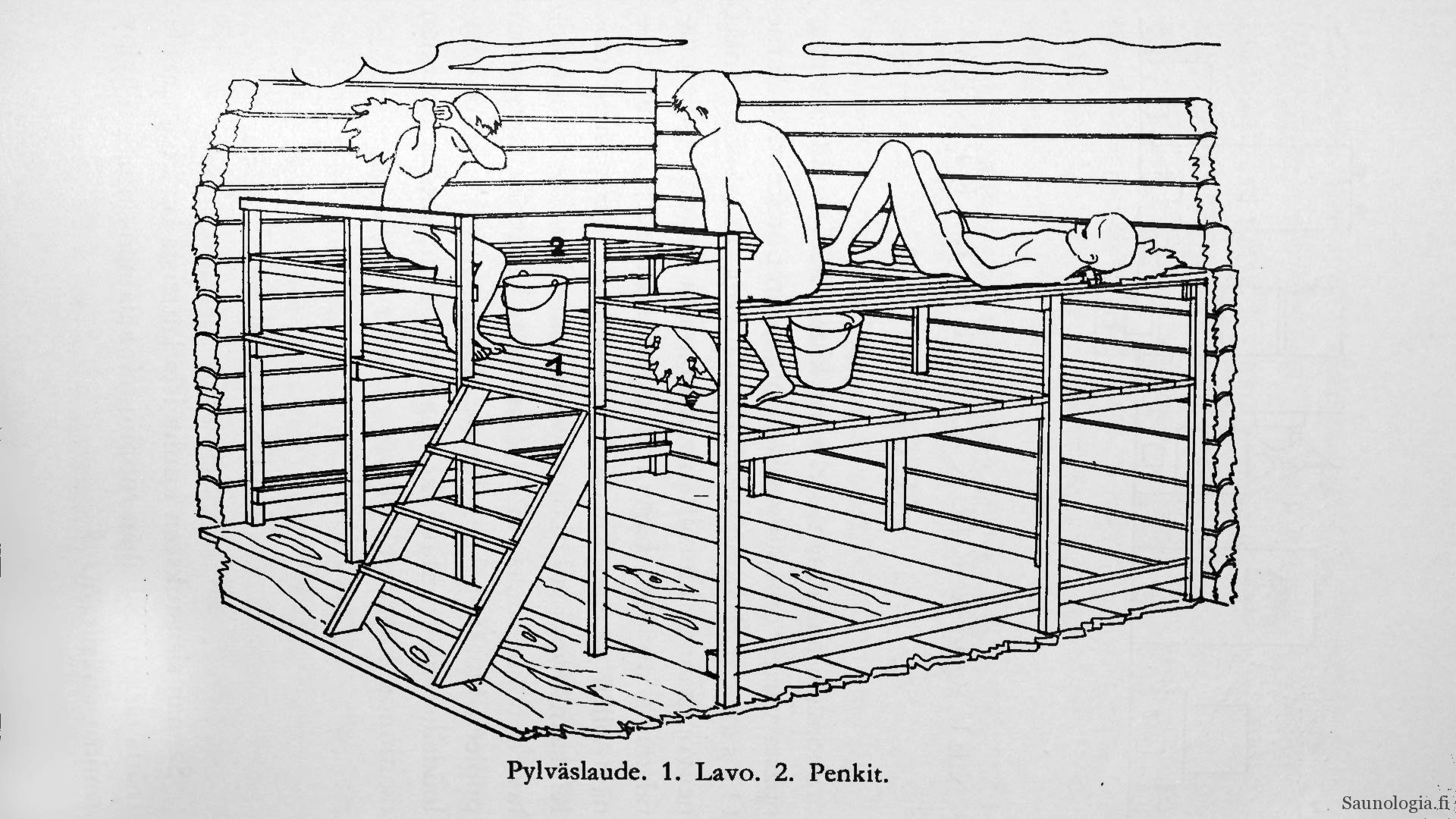
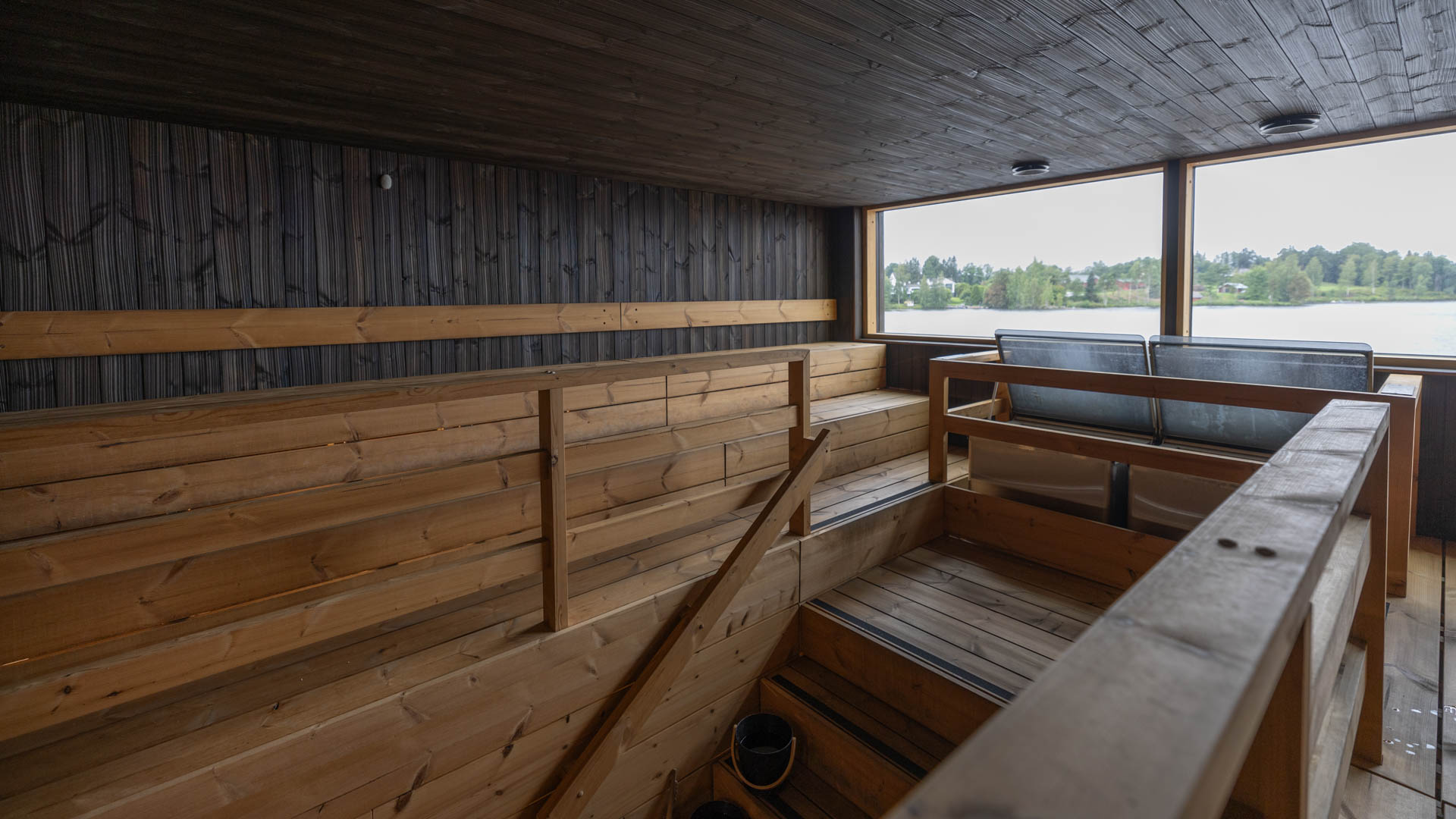
Traditional sauna benches consist of three levels:
- Top level, or upper bench
- Foot level, or lower bench
- Steps, a bench stool or fixed steps
Each level is at a different height. The number of steps needed depends on the proportions of the sauna. If the heater has been successfully recessed to floor level, no steps are needed at all. If the sauna has a two-meter (6.6 ft) high roost-style bench (3.3m, 11′ ceiling), you already need a small ladder to climb up!
The law of löyly
Sauna mythology offers one clear design rule for the height of the foot bench. It is the law of löyly. The claim presented by Sakari Pälsi is taken fairly seriously among sauna enthusiasts. According to the law of löyly, the bather should be positioned so that even the soles of their feet are above the top level of the sauna stones. Many smoke sauna enthusiasts add another 10 cm (4 in) to this. This means that the height of the foot bench is determined by the height of the heater. Ignoring the law of löyly is considered to lead to uneven löyly, possibly too small a löyly pocket, and cold toes (an indication of excessive stratification).
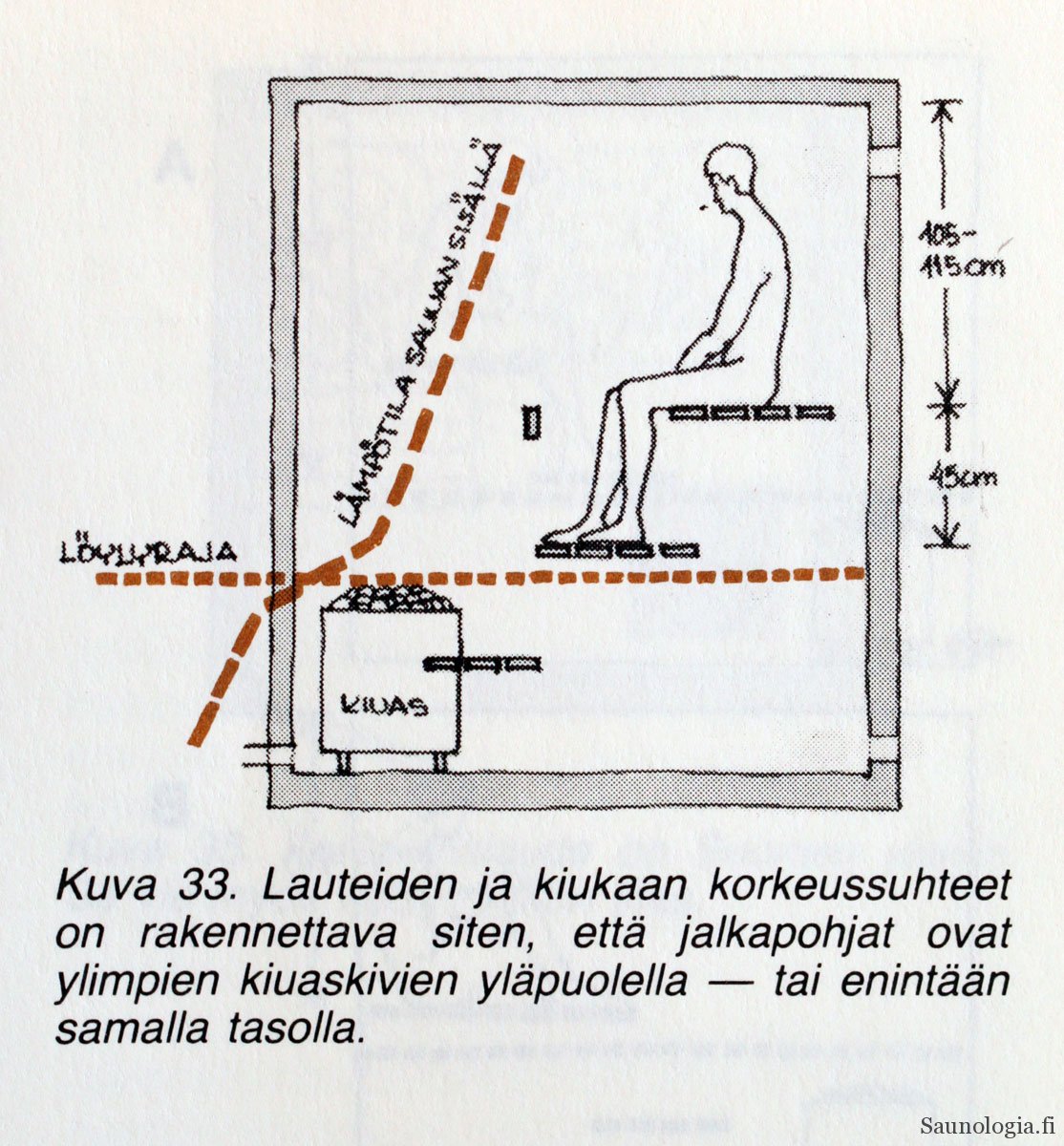
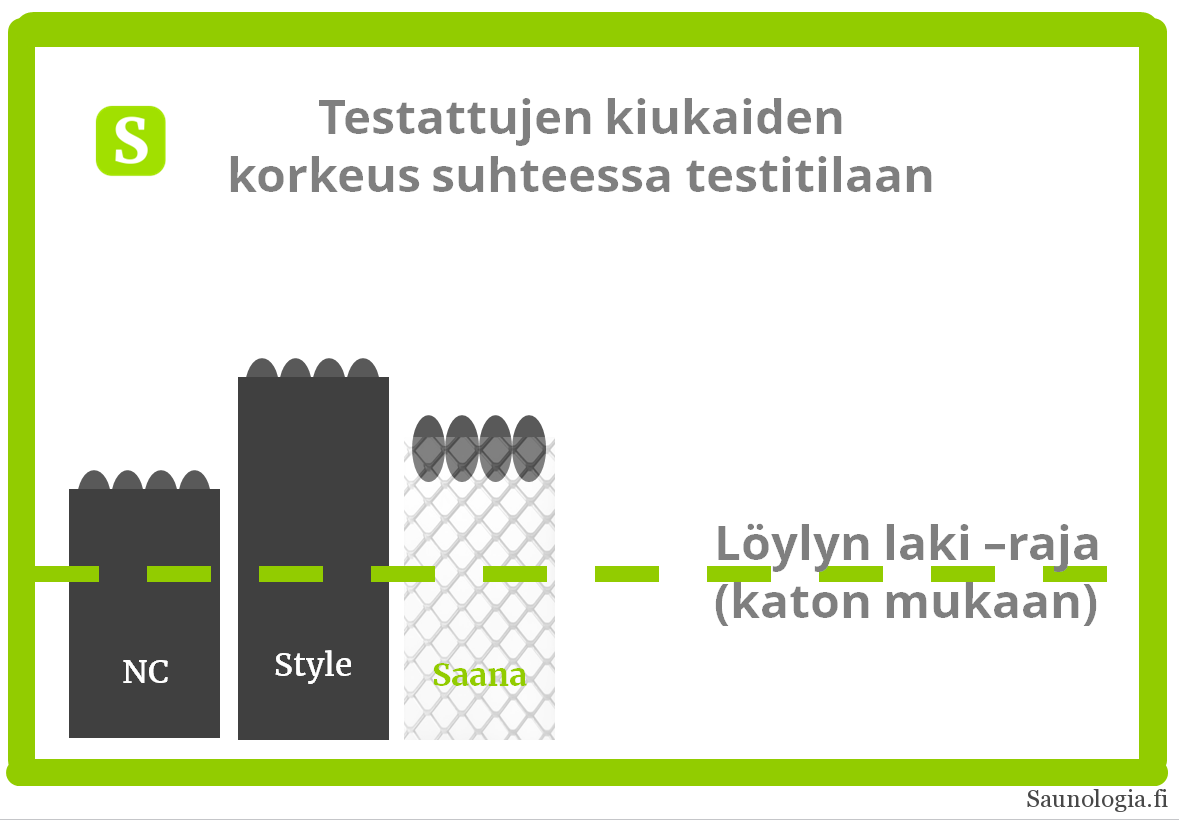
The significance of the law of löyly is open to interpretation. It was originally phrased somewhat humorously and was clearly not intended as a thermodynamic hypothesis, regardless of what the author from an arts background claimed. In addition to the quality of löyly, the relative height of the heater and benches may affect how the sauna room heats up. Manufacturers of tall pillar heaters and mesh heaters in particular have tried to argue that the “law” no longer applies.
However, the matter has not been seriously studied. The law of löyly comes from saunas with natural ventilation, whereas in saunas with mechanical ventilation, heating is no longer entirely at the mercy of natural air movement. Based on my own experience, the law of löyly describes the layering phenomenon of warm, moist air, which should be taken seriously in mechanically ventilated saunas as well (see also Why sauna designers should care about the Law of Löyly and When Löyly strikes again – pilot study findings). We can fight it, but we can’t fully repel it.
According to Saunologia’s preliminary research published in 2019, the law of löyly works as a good guideline with heaters that are open at the sides, but with heaters that are open only at the top, as much as 20 cm (8 in) must be added to the löyly boundary. My current (2026) understanding is that the effect behind the behavior we try to address with the law has much to do with the rising hot air plume that drives the convective loop between the heater and the ceiling. Even if you have a heater open from the sides, the loop will ”capture” the steam and drive it to the ceiling, supported by the basic gravity effect.
Despite the limited evidence, one can say that following the law improves the conditions for a good sauna experience. So it should only be disregarded for a good reason. Historically, poor reasons have included tall barrel-style and masonry heaters, which Pälsi harshly criticized for producing “navel-level löyly.” A good reason might be an air circulating system, such as Saunum.
Accessibility and ergonomic requirements
Because human anatomical proportions are fairly similar, there are several dimensioning guidelines related to bench ergonomics. I have compiled them in the following table. All of these guidelines were originally illustrated in Rakennustieto’s book Saunan suunnittelu (English edition out of print; reprinted in the Secrets of Finnish Sauna Design). The dimensions refer to the distances between the outer surfaces of the levels. Material thicknesses must be taken into account in structural design, and they affect the other dimensions:
| Element | Dimensions |
|---|---|
| Seat bench to ceiling | 100 to 120 cm (39 to 47 in) |
| Foot bench to seat bench | 40 to 45 cm (16 to 18 in) |
| Step height (rise) | 30 to 35 cm (12 to 14 in) |
| Step depth (run) | 25 to 35 cm (10 to 14 in) |
| Seat width per person | 60 cm (24 in) |
| Foot space width | > 30 cm (> 12 in) |
| Seat depth, sitting use | 45 to 60 cm (18 to 24 in) |
| Seat depth, legs folded up | 80 to 90 cm (31 to 35 in) |
| Seat width/length sleeping space with legs bent | 120 to 160 cm (47 to 63 in) |
| Seat width/length sleeping space with legs straight | 180 to 200 cm (71 to 79 in) |
It is clear that in a sauna designed for general use, accessibility factors must be taken thoroughly into account throughout the design. If the sauna must be accessible, for example by wheelchair, the seat bench height must be about 50 cm (20 in) above the floor (ADA requirements are bit lower than that, 17 to 19 in; 43 to 48.5 cm) ).
Other special solutions for an accessible sauna are covered in a separate article on the accessible sauna. Local building control authorities will likely be happy to comment on these dimensions. A great deal also remains the responsibility of the bench designer.
If you are designing benches yourself for your own use, it is not worth relying blindly on average dimensions alone. Instead, think about how many people the benches are intended for and what kind of use they will get. It is worth boldly measuring existing bench solutions and testing different depth and width combinations. Height levels can also be adjusted, especially if the top of your head rises above two meters (6.6 ft).
Including a backrest reduces the available space in direct proportion to its protrusion. If the backrest is 2″ deep, you should leave a similar gap underneath, and for this alone, not have the benches flush with the wall.
Capacity or comfort?
Personally, I have seen many saunas where, in my opinion, too much seating capacity has been created at the expense of bench depth. In a private sauna, a good question is how many people are realistically expected to use the sauna on average. It is not worth building far too many seats if they are not really needed.
Another thing I value is a sufficiently long continuous bench surface that allows you to lie down in the German style. For this, you should allow at least 180 cm (71 in) of bench length.
In spaces where there is no need for compromise, the seat bench should always be designed with generous depth. This is the single most disappointing factor in my own benches. A depth of 60 cm (24 in) is the absolute minimum.
The image below gives some idea of the capacity of different bench layouts
(people = number of bathers, 48″ = 120 cm, 72″ = 182 cm, 96″ = 240 cm):

This article is a 2026 translation of one of the most loved Finnish Saunologia posts of all time!
About Us
Saunologia is the provider of premium Finnish sauna design services for clients worldwide through FinnishSaunaDesign.fi. Led by Dr. Lassi A. Liikkanen, our work combines authentic Finnish sauna expertise, modern design thinking, and technical know-how to create exceptional sauna experiences for homes, hospitality projects, and wellness destinations. From concept design to expert guidance, we help bring world-class sauna ideas to life with credibility rooted in Finland.
Learn more at FinnishSaunaDesign.fi




The last image in this article is not loading
I think it should now work for everyone!