



Tulikivi Kaarna Review: Fast Heating Electric Sauna Heater with Beautiful Soapstone
Tulikivi Kaarna is an electric sauna heater made in Finland by a manufacturer known for attractive-looking products. Kaarna is a compact heater, with a model available in all the usual power classes. In Saunologia’s test, Kaarna was used for a month in mixed home use. In the test, Kaarna proved to be a fast heater, very safe to use and with excellent remote usability. Special praise goes to the consistency of the remote and local user interfaces. In my test sauna, sizing the heater relative to the sauna room proved more difficult than expected, as the stones sometimes cooled too much. Still, the test household ended up missing the heater – read the whole story to learn why!
The company behind the heater
Tulikivi is a Finnish company that has operated under this name for over 40 years. Its history, however, goes back more than a hundred years. Today, as a publicly listed organization, it’s difficult to consider it a family business, although the company is led by a second-generation “Tulikivi person” and significant minority owner Heikki Vauhkonen.
Heater production is thoroughly domestic and entitled to use the Avainlippu (Key Flag) symbol. Only part of the electronics comes from abroad. The most important ingredient, soapstone, is sourced from North Karelia, where Juuka is also the company’s home base.
Sauna heaters have been part of Tulikivi’s business since 1985, that’s over 40 years now. Over the years, the company has produced striking wood-burning models, including smoke sauna heaters. The electric heaters launched in 2009 have, however, become increasingly important. As Tulikivi currently expands its offering globally, from Japan to America, its new releases are interesting to an ever-wider audience.

What is Tulikivi Kaarna?
Tulikivi Kaarna is one of the newest electric heaters from the Finnish company known for its soapstone products. Kaarna was published in 2024. Finished with a recognizable soapstone surface, this pillar-style heater is available in two versions, sizes M and L.
Within these, there are multiple power variants: for Kaarna M: 4.5 kW, 6.8 kW, 8.5 kW, and 10.2 kW. The M size is the base model and appears in many brochures simply as “Kaarna.” Kaarna L, in turn, is either 12.8 kW or 15.3 kW. For all of these, you can choose between two different stone finishes: the traditional smooth soapstone Classic, or the darker Nobile, made matte through water-jet processing.

In addition to higher power, the L is physically larger: the diameter is 430 mm instead of 360 mm, and it can hold more stones. The stone capacity of the base version is approx. 30 kg. This test included the 8.5 kW model, and the article does not discuss the L model further, though the control system is identical in both.
Kaarna includes the typical accessories of an electric sauna heater. The control panel has a wireless network connection (WiFi), which makes it possible to control the heater over the internet from a computer or phone; I’ll cover this more thoroughly later in the article. For remote control, a door sensor is required as a safety device.
Tulikivi’s unique accessory is the bench sensor, which allows the sauna room temperature to be adjusted based on something other than the hot spot close to the heater, which is dictated by safety requirements. Previously, a distinctive feature of Tulikivi heaters was a temperature sensor inside the stone compartment, but this has now been discontinued. In its place, there is a “löyly setting” selectable from the control panel, offering gentle, medium, or strong löyly.
Global availability expanding
Kaarna models are currently available Europe. According to Tulikivi’s Head of Sauna Business, Mikko Kuoppa, company aims to introduce the models in North America and Japan during 2026, once locally certified versions of the heaters are ready. This likely means keeping the looks intact while the internal electronics and power ratings slightly change. This sets a remarkable new domain for Tulikivi heaters.
Installing Kaarna
Typically, a household electric sauna heater is delivered in one large but lightweight package. Kaarna is different. The soapstone heater is delivered in two packages. In the usual lightweight cardboard box is the heater body with its control unit. In the second package, that’s a wooden crate, the cladding stones are carefully packed. The total dry shipping weight is 108 kg, of which about 60 kg is cladding stone.
Installing a floor-standing heater (one that stands on its own legs) is straightforward. In Kaarna’s case, in addition to the heater itself you also need to find a placement for the control unit, which fortunately is IP-rated and can therefore be placed within the protected zones even inside the sauna room. However, for aesthetic reasons this is not recommended.

The most notable feature of installing Kaarna is attaching the cladding stones to the frame. Compared to other heaters, this is an extra step, but for an installer familiar with the work, it doesn’t add more than about ten minutes. The frame has an interesting telescopic structure, allowing it to be raised 15 cm (6″) upward to fit different bench integrations (height range 79–94 cm; 31–37″). In the test installation, the heater was intentionally left in the lowest position.
All in all, installation easily takes close to two hours to get various peripherals, control panel, temperature sensor, and optional door and bench sensors also in place.

Stone fitting and panel mounting challenge
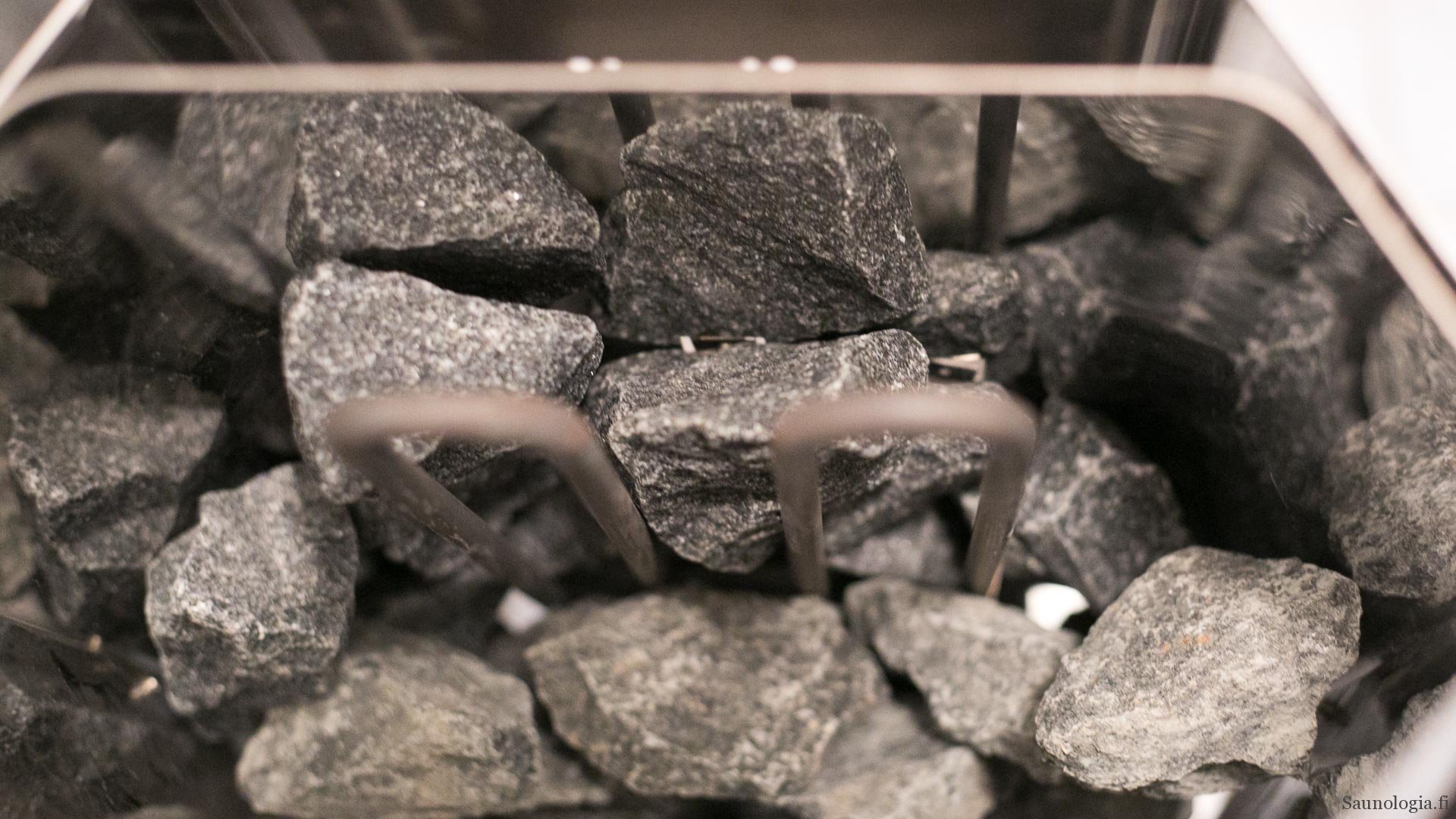
Once the electrical work has been completed and the electrical operation verified, the stones must be installed before the test heating. The stone space is small and has tight spots. I emptied two 20 kg boxes of olivine diabase stones (5–10 cm) and rinsed the stones. After that, I selected stones by size so that I could stack them with suitably sized pieces. This worked on the first try, and the stones did not need topping up later. This means the stone compartment is tight enough that the stones did not shift. About 30 kg of stones fit into the heater quite precisely.
Later inspection or replacement of the stones seems reasonably easy. The heater isn’t very deep, so you can reach the bottom, even if the work isn’t exactly pleasant.

A couple of notes about the installation. Tulikivi’s control panel is designed for an elegant flush mount. The plastic frame offered for surface mounting is not very stylish; using it makes the panel stand too far off the wall. I ended up quickly making a mitered wooden frame from bench material, which allowed me to mount the panel more neatly, though inside the sauna room. Thanks to the panel’s IP rating, this was technically permissible, even though it wasn’t what I wanted. To my surprise, the solution worked quite nicely!

Heater remote operation setup
After stacking the stones, you can start using the heater. Startup begins by switching on power to the control unit, after which the control panel slowly comes to life. Heating can then be started from the control panel. According to the manual, on the first heating the heater is “burn in,” and the sauna room must be ventilated thoroughly before bathing.
This instruction is worth following, because the heater really does emit a noticeable smell. The odor did not recur later in normal use. The cause is most likely grease left on the heating elements during the manufacturing process in the production process of the heater elements.
The second phase is setting up remote control. The idea is that the heater is connected to the home wireless network, from which it connects to a server on the internet. The person heating the sauna connects to the same server with a smartphone or web app to command the heater. This requires connecting the control panel to the wireless network and linking access rights to a phone number. This is fairly easy, at least if the network password isn’t cryptic.
Installing the mobile app on an iOS or Android device proceeds in the usual way. Tulikivi has chosen a so-called hybrid model for the mobile implementation, which means the heater can also be controlled from a computer’s web browser, adding flexibility. Multiple devices and users can control the same heater after loggin in. As a nice detail, all interfaces are almost identical, which reduces the user’s cognitive load.

User manuals
The heater package comes with comprehensive user instructions. The instructions are professionally written, laid out, and illustrated, and delivered in landscape A4 size. As a special surprise, the Tulikivi app has a paper manual. This is exceptional, because apps usually evolve faster than printed material, and on the other hand their usability is expected to be good enough that instructions aren’t needed.
Overall, the comprehensive guidance is clear and understandable enough. However, I’ll point out two items that stand out from the heater’s own instructions. The first concerns ventilation, whose guidance Saunologia examined closely in summer 2025. In this respect, there are contradictory instructions regarding natural (gravite-based) ventilation and, more broadly, the implementation of ventilation as a whole. Otherwise, the instructions generally refer to a widely known Finnish RT card, which is an acceptable option, so this detail is not problematic.
The second note concerns sauna stones. Here too, the use of ceramic stones is prohibited, but in addition the manufacturer requires using stones sold by Tulikivi Plc. The latter requirement is odd, because Tulikivi sells technically the same stones as other brands, but most ordinary retail outlets do not offer stones branded by Tulikivi. So this can cause problems. On the other hand, due to the similarity of the products, it is difficult for the manufacturer to point the finger at the consumer if this requirement has been violated.

Experiences using Kaarna
One appeal of Tulikivi’s entire range, including Kaarna, is its impressive appearance. Once Kaarna was in place in a dark-paneled sauna, I was immediately ready to admit that light soapstone is an excellent match for a dark thermo-wood interior. Until now, the heaters tested have been either dark or shiny stainless steel.
My first experience was: now the sauna heats at record speed! Before this, I have tested more than a handful of different electric heaters in the same room, but usually we haven’t reached a heating rate of >1°C/minute. Now the sauna heated even faster than that!
The temperature sensor and the integrated overheat protection are located on top of the heater or on the side wall in the immediate vicinity. This means that if you want a true 75°C temperature in the sauna, you need to set the heater to aim for just under 90°C.

Kaarna gives you tasty löyly right after heating. After a couple of ladles, the joy of löyly fades a bit, because the heater doesn’t seem to heat the stones immediately more. This, of course, leads to the inevitable cooling of the sauna stones. The very quietly operating heater takes fairly long breaks. This is a combination of changes in sauna room temperature and the heater’s way of responding to that change.
Explaining the cool stone volume
The stones in Kaarna were able to cool down because the heater was too powerful for my sauna room. Because the heater had a lot of power relative to the room, it could raise the room temperature faster than the stones had time to gain additional heat. As a result, after the first round of löyly, the stones no longer had time to get properly hot again. This is demonstrated by the accompanying electricity use graph, which shows that the heater is on only very sporadically after the initial heating.

The stone-temperature challenge is not critical, but if you – like myself – happen to prefer lower bathing temperatures with proper löyly, Kaarna’s thirty kilograms of stones, heated with this logic, doesn’t really isn’t enough.
I had to admit that this time I had installed a heater that was too powerful for my sauna!
The best way to compensate is simply to set a higher temperature for the sauna. I don’t personally like this solution, but with Kaarna it works. At a higher room temperature, you need to pour less water for a similar effect, and the heater is on more frequently and for longer because heat loss is greater. As a result, the stones don’t cool down as much either.
Another challenge in use is the heater’s height. Even though this tower is not among the tallest, it is tall enough relative to the test sauna (79 cm; 31″ in the lowest position) that the top of the heater rises a couple of centimeters above foot-bench level. This usually leads inevitably to a significant, user-noticeable temperature difference between the foot bench and the upper bench.

Advantages of soapstone in a sauna
Soapstone cladding on a heater is rare. At the moment in Finland, only Tulikivi uses it extensively. Occasional stone surfaces can be found in products from a few other brands, such as Sawo.

As a material, soapstone stores a lot of heat and releases it gradually. It is excellently suited to the sauna environment. As a cladding, it keeps the heater’s surface temperature under control; according to this test, usually below 80°C. This increases operational safety and comfort, because when sitting nearby you don’t even notice the heater’s presence as a strong source of radiant heat!

The model of Kaarna shown in the photos still has a round metal frame at the top of the heater, but this has been removed in newer production units, further minimizing the risk of burning your fingers on the heater’s edge.
Heat stored in the soapstone cladding gradually transfers into the room, helping the sauna dry out after bathing. Although the heater, in a sense, has more thermal mass than the weight of the sauna stones alone would suggest, you cannot throw löyly onto the stone cladding: the stones are not hot enough for that purpose, and water splashes would eventually ruin the appearance of the stone.
Löyly modes and the bench sensor in the test
A special feature of the heater’s controls is three so-called löyly settings. The idea is that during maintenance heating, the elements can be controlled to heat either the stones or the air more. The effect should be noticeable after the first heating cycle: i.e., once the heater has already brought the sauna room to the target temperature.
Despite multiple attempts, I couldn’t get any significant effect or added value out of the löyly settings. I suspect the problem was that regardless of the setting, the heater brought the room air back to the target temperature so quickly that no noticeable difference had time to emerge. Keeping the sauna door open longer did not prove to be a feasible way to compensate for the situation.

The joys and sorrows of the bench sensor
The bench sensor is a parallel way to measure and control the sauna temperature. The prevailing problem in heaters today is that the combination of temperature sensor and overheat protection favored by manufacturers must be installed in the hottest possible location in the sauna. This means mounting it on the ceiling or wall above the heater. The consequence is significant – up to a couple dozen degrees – differences in the sauna’s average temperature at head height compared to the temperature shown on the heater’s control panel. The user must compensate for this by setting the sauna hotter.

Tulikivi has decided to fix this problem with a bench sensor, which moves control of the room temperature to some other point in the sauna. At first I was excited about this, because it corrects the situation where the control panel and the traditional wall thermometer are far from each other. If you are truly interested in sauna temperature, the solution called a bench sensor makes it possible to manage it more intelligently.
This solution has some downsides, too. First, you have to unlearn old bad habits and stop heating the sauna to 90°C if the goal is 75°C. Second, I suspect that for this particular heater–sauna combination, the bench sensor made the cooling-stones issue I experienced worse.
A sensor mounted on a wall far from the heater likely reacts more slowly to room temperature changes than the area near the heater. This was partly a feature of the test sauna, because the heater is by the doorway, where incidental ventilation can speed up local cooling of the room air when the heater is off. Still, I can recommend the bench sensor with reservations: you just have to understand how it affects the heater’s behavior in that specific sauna. That way you can judge whether it does more harm than good.
Experiences with Tulikivi’s remote use and control panel

I was skeptical about the control panel that ended up inside the sauna room, but in the end I was pleasantly surprised. A bit of moisture on my fingertips didn’t mess with the touchscreen’s operation, and once it started up the panel was always very responsive (i.e., it reacted without delay to user actions), which is not a given in this product category. The display’s viewing angles aren’t very wide, but this isn’t a critical issue because you don’t need to fiddle with the screen constantly.
Overall, the panel does its job well
Tulikivi’s remote control is implemented in a fun way: the mobile and web app interface matches the physical control panel exactly. This improves usability. The safety mechanism is implemented so that after a door opening, you must acknowledge the safety alert on the physical control panel, after which remote start works again until the next heating session.

The control panel is versatile and can control additional devices installed in the sauna. Such add-ons include, among others, lights with a dimmer, a fan, an auxiliary heater, and the bench sensor. This test did not examine how these work.
There is one shortcoming related to the app’s technical implementation: the app cannot send notifications (push notifications), which competing products use to communicate special situations to the user. Such as that the sauna is now warm. This is almost a basic feature in the mobile world, so it’s something one would hope to see from Tulikivi in the future as well.
App and user interface improvement ideas
The shared user interface could use some improvement. With a quick usability review, there are two larger issues in the UI. One of these concerns the primary action button, or rather, its absence.
In graphical user interfaces, the convention is to use a clear primary action button (a so-called call to action, CTA). In Tulikivi’s case, a visual button is missing; instead, the user has to realize they should tap text whose content changes depending on the heater’s state. This leads to the next problem: understanding the heater’s state (on vs. off) at a glance from the interface is not self-evident.
The rest of the UI issues are smaller and do not significantly hinder everyday use. A strong point of Tulikivi’s technical solution is that all user interfaces can be updated easily; even the network-connected control panel updates automatically if the app is updated.

Kaarna’s energy consumption
I tested Kaarna intensively over six weeks, during which there were 28 heating sessions and average energy consumption was 8.7 kWh. Compared to benchmarks for the same room, this is clearly below average, even though I repeatedly kept the heater on longer than normal to test the operation of the löyly settings and changes in stone temperature. At best, a quick sauna session used under 7 kWh, thanks to the fast warm-up.
Summary: feelings after the test
After the test ended, the family’s thirteen-year-old soon asked, “where is that good heater now?” I had to say it had been returned to the manufacturer. The young user had appreciated the heater’s löyly setting, and although I consider this a placebo effect myself, it was interesting that having the control panel placed inside the sauna room clearly influenced the user’s sense of how controllable the bathing conditions are. I didn’t expect that.
When I disassembled the heater for pickup, I made one surprising observation. The sauna stones from about three-quarters of the way up from the bottom had visibly aged. Stone dust had accumulated under the heater as usual. The extent of aging was a big surprise, given only about 30 active heating hours.
In Saunologia’s sauna stone durability tests, the results with olivine diabase have generally been better, and of course, here most of the stones were intact. The reason must lie in the heater’s structure, which heats the stones in that part of the heater significantly, while at the same time transferring heat efficiently into the sauna room. In any case, I would personally recommend using ceramic stones in the heater’s inner section – if you can find ones small enough.

There were hardly any signs of use on the heater itself or the elements when the test ended, so the heater can be expected to serve easily for ten or twenty years. Considering the heater package’s price tag of over €2,000, that’s how it should be.

This brings us to the final consideration: is the heater worth its price? Tulikivi has managed to create a price point in Finland for uniquely interior-design friendly heaters, one that many competitors can only envy. Based on this test, Kaarna does not lose technically to its cheapest competitors; on the other hand, it involves the same sauna-fit challenges as many other models. Power and sauna height must be taken into account seriously to get the best fit. I would recommend a minimum ceiling height of 230 cm.
The heater has many strengths and is best suited to an environment where looks and effortless sauna heating are valued. If the user prefers higher temperatures, Kaarna delivers well. Remote use is effortless and pleasantly consistent across all controllers. The usability shortcomings will surely be fixed in the near future.
|
Good |
Needs improvement |
|---|---|
|
Fast warm-up Consistent user interfaces Looks |
Stone amount and löyly capacity Stone aging Price |
This article has been produced in commercial collaboration between Saunologia and Tulikivi.



Thanks for the article.
How did you connect this heater electrically? I bought it for my sauna, and when I saw 100 places where the electric cable is connected, I was shocked. Could you send me a photo of how you connected it electrically?
Thanks in advance,
Hello Adrian,
Thank you for asking. Unfortunately electrical wiring is not something I usually comment on in the blog posts, because the Finnish law requires authorized electricians to do all installations, so I have felt reluctant to offer any advise in this regard.
All heaters, including Tulikivi, should come with wiring instructions that trained installers should understand.