



Safe Sauna Design: Preventing the Next Tokio-Style Tragedy
On December 15, 2025, a Japanese couple in their thirties were found unconscious in a sauna. They had rented a private sauna inside a larger complex called Tiger Sauna in Tokyo. During their sauna session, something went wrong, and later both patrons succumbed to their injuries in a hospital. I believe following simple Finnish sauna design principles could have saved these lives.
From a Finnish perspective, I believe that these deaths could have been avoided by following simple design principles commonly observed in Finland. That is, the sauna door must be an emergency exit door. Use door mechanisms that never lock, but always allow the door to open outward. In the following, I recount a similar incident from a few years back, sauna-related death risk in Finland, and the simple ways we can minimize these risks. But let’s begin by reviewing the latest tragedy.
What happened in the Tokyo sauna accident?
An incident described as a “fire” by the sauna operator Sauna Tiger in Akasaka (Minato-ku, Tokyo) resulted in the death of two patrons. The couple (reported as Matsuda Masaya, 36 and Matsuda Yoko, 37) had apparently become trapped in a private rental sauna. A detached door knob was found on both the inside and outside of the sauna room. Signs of fire, an attempt to open the sauna door by force, and a failed emergency help button were discovered at the scene.

What seems to have happened is that the regular door handle had become loose, preventing the couple from exiting normally. Based on Sauna-Ikitai user reports, the small sauna had a high temperature (90 to 100°C) and low-humidity environment, in which users spent a maximum of 15 minutes at a time.

https://news.tv-asahi.co.jp/news_society/articles/000474853.html?
The official cause of death has not yet been confirmed. While there were apparently some burn marks on the bodies, the exact reason remains unknown. What is certain is that even without fire, a person will be overheated and dehydrated in the extreme heat and die if the exposure continues long enough because of heat stroke, heart, or kidney failure.
Additional Japanese sources: https://www.city.minato.tokyo.jp/houdou/kuse/koho/sonota/20251226_press01.html, https://www.fnn.jp/articles/-/980567, https://mainichi.jp/articles/20251225/k00/00m/040/267000c
Past sauna incidents in Europe
In 2017, two Czech women died inside a garden sauna in a somewhat similar case. They too got trapped inside a sauna when the door locked, failed to escape the heat, and eventually died. The sauna owner was later found guilty but received only a minor penalty.
Here in Finland, deaths in sauna are more common than you might think. On average, about 40 people are found dead in a sauna each year. Most of them are male and deaths happen inside private saunas. No deaths have been recorded inside public saunas for decades (with the exception of the notorious “Sauna World Championships” of 2010). The cause of death in this statistic is always heat stroke. This is almost never because of technical problems with the sauna.
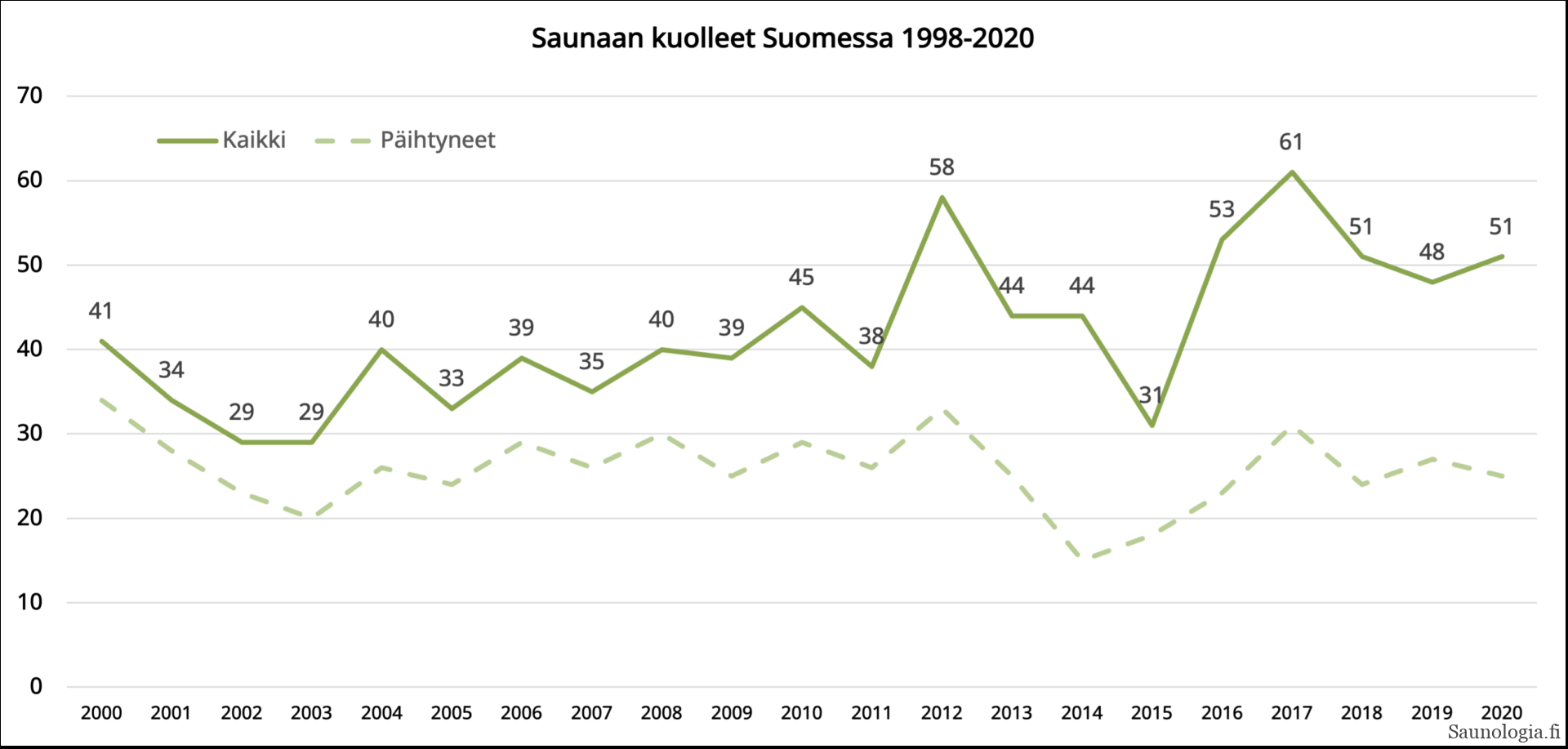
Sauna death risk in Finland
While the number of incidents may sound high, we must evaluate the situation in proportion to the number of sauna visits. Because in Finland, we have 5.5 million people (4.4m between 15 to 80-year-olds), 60% of which might use the sauna once a week, some more often, I estimate we have about 400 million sauna visits taking place every year. Others estimate more than that.
When we now calculate the risk of death, it comes out to one fatality per ten million visits. That suddenly seems less risky, particularly considering that around 30 times more people are found dead elsewhere in their homes each year.
The sauna deaths are currently being studied by the national public health body in Finland to understand the full spectrum of death causes and their exact number beyond heat strokes. Some risk factors are evident from the existing research. First, at least half of the deceased were intoxicated by alcohol, drugs, or both. Second, the majority were using their private sauna on their own, so nobody was looking after them. For instance, if a person passed out while in a sauna, they would eventually perish as they overheated without anyone to notice before it was too late.
Two simple ways to avoid sauna deaths
At Saunologia, I advocate safe, sustainable, healthy, and authentic Finnish sauna design. In our designs, we follow this and many other principles that ensure safety and are simple, but easily neglected by designers and builders outside Finland.
When we humans get too hot, we naturally flee the heat. Outdoors, we seek shade from the sun, in the sauna we leave the hot room.
So, make the sauna door an emergency exit door. Never use locking systems or practices that can trap users inside. I don’t mean a construction with a door with a wide horizontal push bar, but a simple mechanism that prevents the door from ever getting jammed. The traditions across countries differ on whether doors generally swing outward or inward, but a Finnish sauna door should always swing outward to facilitate exit. If you must control the access to the sauna, prefer removable padlocks or other mechanisms that satisfy the emergency exit principle.
Make the sauna door an emergency exit door.
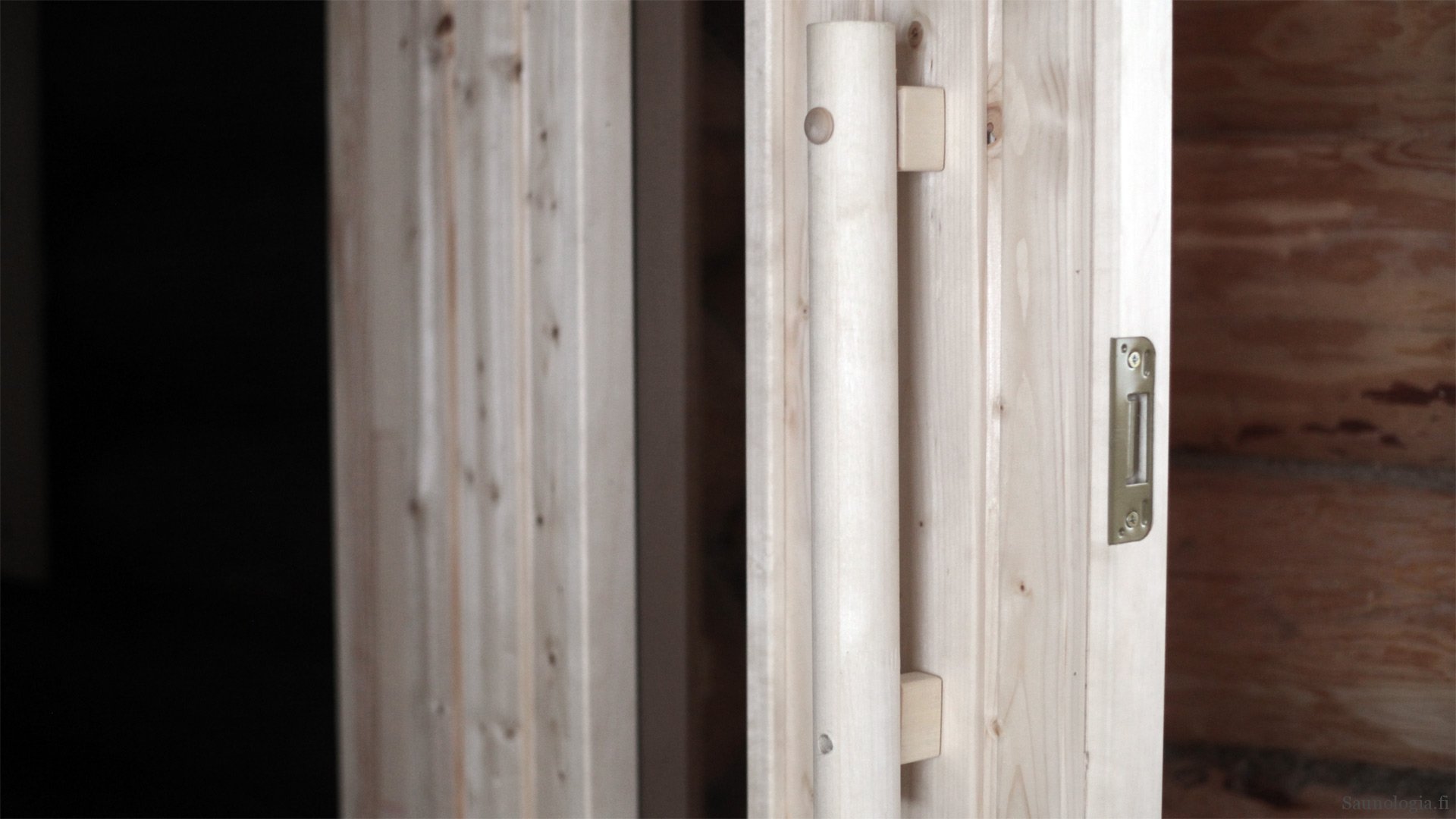
In Finland, many sauna doors utilize a roller latch (“rullasalpa”). This is a very simple device that helps to hold the door closed even when powerful löyly is created but it is also weak enough that at least school-aged kids can open the door themselves. In fact, it is better that the smaller kids can’t access the sauna themselves, so this is a good solution for private saunas.

Don’t sauna alone and intoxicated. The risk of serious injury or death multiplies remarkably if you go to the sauna drunk. Most Finnish people know a person or two who has gotten at least severe burns by contact with hot surfaces when heavily under the influence. At worst, we have people who’ve died as a consequence of falling asleep in a sauna. I personally have met at least one person whose mother later died this way.
Other safety precautions
I don’t particularly favor separate safety mechanisms. In the Tokyo fatality, the emergency call button was apparently engaged but found dysfunctional. More active staff surveillance would have been preferred. However, no sauna operator wants to spend time “spying” on their customers for privacy and efficiency reasons. Thus, the number one solution is the emergency door, second the social surveillance.
And of course, don’t mix sauna with drugs or drinks that risk you passing out. In public settings, intoxicated patrons should be guided somewhere other than to the sauna. However, I do find sympathy for a sauna timer, either separate or integrated limited running time in an electric sauna controller, to turn off the sauna after reasonable running time. I just don’t think the idea of 1 h sauna embedded in the old American UL 875 standard was a good one as it dismisses the heating time altogether. In the German sauna tradition, sauna patrons often rely on an hourglass to time their visit. There’s nothing wrong in doing that, but it won’t wake you up if you fall asleep.
More complex solutions can include fire alarms and sprinklers inside the sauna, connected to a central alarm system that alerts staff to the emergency. While these can and have been technically utilized, their complexity, additional cost, and usefulness do not come close to the simple ways of avoiding harm. For one, people very rarely die because of fire (carbon monoxide poisoning or burns); instead, it’s the sauna itself, working as intended, but people being inside for too long. It is always better to save yourself.
Finally, many Tokyo saunas have poor ventilation. I don’t know the situation at Tiger Sauna, but proper ventilation can also be important for health and safety as it helps us to feel good in heat.
Saunologia sends its condolences to family and friends of the victims of the Tokyo sauna disaster. Sauna is a place for wellness, it should not become a death trap.
The featured image was created using ChatGPT 5.2.


Hi,
thank you for a very good article! I would like to add that on the cruise ship where I work as an engineer, we had a case where an adjustable roller latch as seen in the picture in the article (unsure of the brand though) had come out too far from the door frame. In practice what happened is that the latch entered the door frame beyond the center of the roller. As a result it functioned as a normal latch and pressing on the door no more drove the roller latch inside the door thus prohibiting opening the door. We had an alarm button in the sauna and the two bathers were helped out from the outside.
I would add that in case one gets stuck in the sauna it is good to check if the heat can be shut off from the stove, avoid panic and lay on the floor while waiting for help.
Thank you Kurt for an excellent comment!