


Inside the Nordics’ Only Accredited Wood-Burning Sauna Heater Lab
Since July 2026, a small, unassuming laboratory in southeastern Finland entered a new phase in its history. The lab, run by the South-Eastern Finland University of Applied Sciences XAMK, has just received accreditation to provide the test services required for wood-burning heaters in the latest phase of its over 15-year existence.
In the EU, a fresh standard for continuous wood-burning heaters (EN 16510-2-10:2025) will come into full effect on February 7th, 2027. This has prompted both labs and heater manufacturers to retest their product lines to remain eligible for the CE marking (”label”) and continue distributing heaters after the deadline. This change is the biggest in 13 years and prompted Saunologia to investigate what the new testing protocol looks like.
Finnish summary / Lyhyesti suomeksi:
Kaakkois-Suomen ammattikorkeakoulun Xamkin Kouvolassa toimiva testauslaboratorio on saanut akkreditoinnin uuden EN 16510-2-10:2025 -standardin mukaisiin jatkuvalämmitteisten puukiukaiden testeihin. Uusi standardi korvaa aiemman EN 15821 -standardin ja tuo testaukseen uusia päästömittauksia, kuten hiukkasmassan, typen oksidien ja orgaanisten yhdisteiden mittaamisen. Saunologia tutustui, miten kiukaiden turvallisuus- ja päästötestit käytännössä tehdään aina vakioidusta polttopuusta ja savukaasujen hallinnasta pintalämpötilojen, suojaetäisyyksien ja hiukkaspäästöjen mittaamiseen. Uusi testausjärjestelmä lisää vertailukelpoista tietoa markkinoille tulevista kiukaista, mutta kuluttajan näkökulmasta ongelmaksi jää edelleen se, ettei mittaustuloksille ole yhteisiä rajoja, joiden perusteella eri tuotteiden ympäristövaikutuksia voisi helposti vertailla, tarjolla on pian vain lisää vaikeaselkoisia numeroita.
A truly niche business
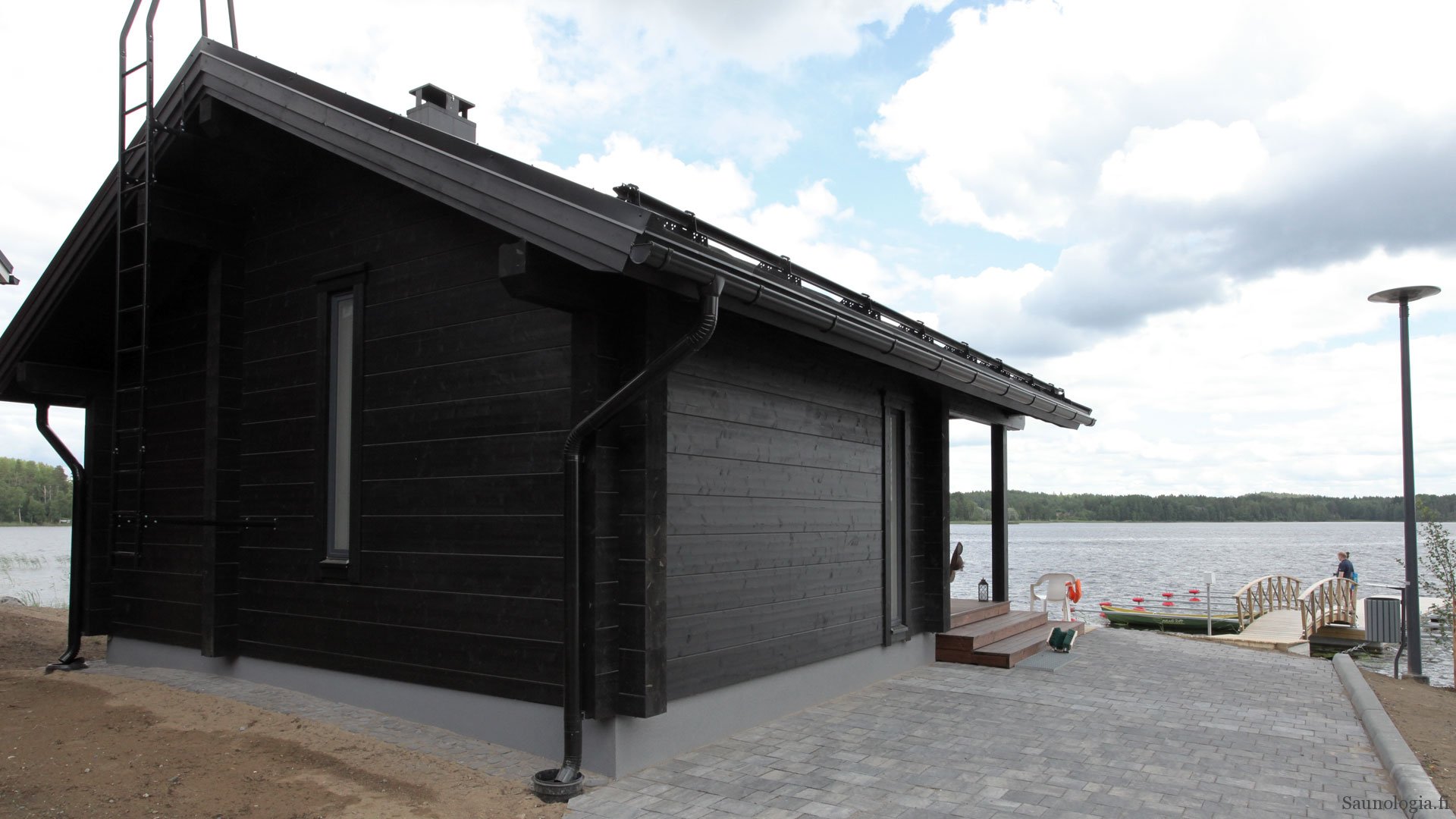
Testing wood-burning heaters to standard is a demanding, controlled process with a relatively small pool of paying ustomers. Most heater manufacturers are based in either Finland or the Baltic countries. So it is somewhat surprising that the only lab in the region is in the small town of Kouvola, in a brand-new, small industrial building in the historical, rural Anjalankoski district. The lab is run by a university of applied sciences, which in this case means it is used exclusively for testing, not product development.
As the Saunologia team arrives early one July morning, we are greeted by the full staff of three lab engineers, led by Mikko Nykänen. Only the managing director of lab operations is absent, enjoying her vacation. He has been with the lab since its inception, which happened when the EU ruled in the early 2010s that heaters sold in the EU must pass certain product requirements defined in the EN 15821:2010 standard or cease to be sold from 2013 onwards.

A new standard, new measures, new confusion
In May 2025, a new standard, called EN 16510-2-10:2025, or just 16510 from here on, was published to replace the previous one (15821). Its acceptance was preceded by years of trepidation for the future of wood-burning stoves, at least among Finnish sauna fans. The concern was that EU was pushing all wood-burning appliances towards common, very strict emission and efficiency standards known as the Ecodesign 2022. This would have caused major disruptions, as prior research at the University of Eastern Finland’s FINE laboratory (reported at length in Saunologia’s Finnish articles) showed that the common Ecodesign standards would be very difficult to meet with any existing heater design.
So, years passed, other types of stoves (fireplaces, room heaters, etc.) received their expected requirements well before 2025, but the future of sauna heaters remained unclear as they explicitly excluded sauna stoves from the rest of appliances.. The committee behind the new standard included Finnish sauna industry representation, which may have influenced the decision to take a surprisingly lenient approach to emissions in 16510.

In 2025, the new standard did include the emission categories mandated by Ecodesign, but it did not set any performance level requirements. In fact, the new standard abolished even the old requirements that were in place for efficiency and carbon monoxide emissions! So, in a way, the equipment manufacturers got an easy way out. However, it’s still not an easy or cheap escape, as the producers that want to sell their heaters in 2027 must re-certify their equipment with haste against the new standard that includes new measures such as particle mass, nitrogen oxides (NOx), and organic compounds.
The confusion in the domain comes from the expectation that just measuring these variables will not be enough for the EU in the long run, and one day, there will be performance requirements. But that day has not yet come , to the relief of wood-burning heater fans and producers, and maybe to the disappointment of environmentally aware people.

How the testing works
In brief, manufacturers order a test, ship the heater with instructions, and wait for the results. The job at the lab takes a couple of days, from unpacking the heater to putting it through the test. Like consumers, lab engineers must burn in the heater outside the lab to keep the air inside the ventilated and air-conditioned lab clean.
The tests take place at two locations around the lab. Emissions and safety testing take place at separate locations. The emissions test must be completed twice, with repeatable results (+/- 10% margin) across the test runs. Greater variability requires repeating the test until the findings are reliable.

There are several common elements to the tests. To run tests, “standardized” firewood, here dry (12-18% humidity) birch without bark, is used. For lighting a fire, chemical fire starters are applied to guarantee no delays. The firewood must also be certified and standardized as far as possible; luckily, another arm of the lab business is accredited for fuel certifications. The exhaust system is mechanically controlled, and its draft is stabilized at 12 Pa.

Safety test
Safety testing is performed to ensure the product is safe; i.e. manufacturer-reported safety distances are valid. The lab does not seek to determine the distances, it verifies that the distances declared by the manufacturer meet the safety requirements.
In practice, this means that the stove is heated in a “test sauna” which can be adjusted to any volume (up to 30 m3; 1030 cu ft) the manufacturer recommends. As the manufacturer’s recommendations involve a range of volumes, the smallest and therefore most fire-prone size is chosen.

The ceiling height is also adjustable to accommodate different heaters. Note that the size restriction also creates a loophole for the most powerful heaters, as specifying a heater for spaces over 30 m3 will prevent it from being tested. Occasionally, local Finnish authorities may request on-site testing for these models as well. In that case, Mikko will pack his equipment and perform the safety test on the customer’s premises.
Safety testing requires heating the sauna up to 110°C (230°F). That’s not done in a single push, but first the heater is allowed to settle at 60°C (140°F) before it’s run at full power. The heater passes the trial if the surfaces remain below 140°C (284°F) when the ambient temperature is regulated at 20°C (68°F). That’s a high figure that, in the long run, would cause the wood to darken and char, but will not create a fire.

The stove temperature and the surface temperatures at the safety distance are measured. Measurements are also taken from the handles which users may operate when the heater is in use. The surface measurement points are chosen based on the heater’s hottest spots. Heaters can be tested with and without shielding, and the combination of the two will receive its own acceptance independent of the heater.
Emissions test
“The critical part here is fast ignition of the first batch. If the firewood fails to catch fire very fast, the whole test run will be ruined as some measures are time sensitive,” says Mikko Nykänen about the emissions testing. The test run begins when the fire is burning at a specific rate (CO2 threshold), but in a failed experiment, this may be achieved faster than the fire builds up, causing an unwanted drop in subsequent measurements and disqualifying the run. To avoid this, the fuel and ignition must be uniform.

Unlike safety, emissions testing closely follows the usage instructions the customer provides. These are candidates for becoming final consumer instructions, provided the results are satisfactory. As the current situation stands, the only thing the manufacturer needs to worry about is that lab staff fire up the stove with care and receive reliable readings – which always eventually happens. As there are no numeric criteria of how much of each emission component is produced, the priority is that the measurements exist, not what they are.

Most of the test results are recorded with digital instruments so the measures are visible in real time on a large screen on the lab wall. They will be later transformed into a written test report and communicated to customers in the user manual as well as on a rating plate fixed to the device.
How fine particles are measured?
There’s a wordplay in the heading’s question (or at least an attempt). Despite much bad press about fine particle emissions and their health hazards in the EU, the Ecodesign protocols don’t measure fine particles (PM 2.5, PM 10) separately. They only target the total particle mass of all released particles (the so-called EN-PME method). That is easier to measure and does not require diluting the test samples.

The total particle mass is measured by filtering exhaust fumes through a temperature-controlled sampling tube for a specific time. The sampling process is tricky to implement, but the results are straightforward. The filter is dried, and the remaining mass of all particles is weighed and reported as mg per m3 (weight per volume).

EU countries vary in this regard. For example, Germany has adopted BImSchV Stufe 2 requirements with a different mass measurement protocol (DINplus / DIN SPEC 1101) and a threshold for passable products. This has seriously limited the consumer options for wood-burning heaters.

Looking out for a greener future
In this story, I have tried to capture the most interesting empirical items of the test protocol, not all of them. For me personally, it was exciting to see what the current state of the art in wood-burning heater lab tech looks like. For me, spaces like this always inspire to do more research.
On a very different level, I think the new 16510 standard involves the right elements and can help to promote a more environmentally friendly and sustainable future for sauna heaters. It’s great we have a facility in Finland to help bring them to market. Unfortunately, the standard does lack performance requirements, which means consumers will be none the wiser when choosing “green” heaters in the near future.

I am very interested to see what numbers the newly tested heaters deliver once they hit the market in six months. It will also be interesting to compare EN-16510 results to the few published BIMSCHv2 test results that employ a similar but not identical protocol.
Before 16510 heaters become available in the EU, a new directive (2024/825) on greenwashing is set to come into full effect in September 2026. It will restrict companies’ marketing claims about environmental effects. Overall, I expect that the growing number of test results means neutral, third-party organizations, such as Saunologia, will still have to educate consumers about which heaters are least polluting.
Thanks to Mikko and Tomi for welcoming me to XAMK and offering a lunch, and to Aapo for supporting photography like the one below.