


Sauna Heater Elements Explained
The critical component for the operation of an electric sauna heater is the electric heating element. This simple part does the most important work in heating the ”electric” sauna. After the sauna stones, it is usually the next part to be serviced. Because this is a consumable part, it is reasonable to ask whether there are differences between elements and, if so, what causes them?
For this article I interviewed Finnish representatives of both element manufacturers and sauna heater manufacturers. The conclusion is that there are justified quality differences between heater elements, which are also reflected in the price of the final product, but the quantity and significance of the differences remain unknown.
The anatomy of a heater element
An electric heating element is a simple electrical device in which the current flowing through a resistance wire encounters a designed resistance. The movement of electricity against resistance consumes electrical energy, causing the wire to heat up. Inside the element, the resistance wire is hidden under the visible metal sheath of the element and protected by an insulating layer. The energy consumed by the wire equals the power of the element, i.e., the wattage of the product, say 3000 watts. The heating element is also known as the heating coil or a Calrod, the latter being a misleading generalization referring to a GE brand kitchen stove heating elements.

Surrounding the wire, a sand-like magnesium oxide or similar material is used as insulation; it does not conduct electricity but conducts heat well. In this way, the heat is transferred from the wire to the visible sheath of the element, from where it is further conducted into the air or the sauna stones. As a result, we see a working element glowing red at a controlled operating temperature of around 500°C. The sheath is made of less than a millimetre-thick steel.
This basic structure is practically the same in all heating elements. To be able to use such an element, the resistance wire must be connectable to the heater’s electrical system. This can be implemented in several ways, such as with a flat connector. The way the connector and its foot are attached is the last feature of the element that deserves attention.
A heater element therefore has four main parts:
- Resistance wire
- Insulation
- Sheath
- Electrical connector and fixing flange
Product features of a heater element
As an operating environment for a heating element, a sauna heater is more demanding than average. The elements are often subjected to mechanical stress from the sauna stones, rapid temperature changes and possible mineral deposits from the water thrown on the stones.
An important difference compared with, for example, water heating is that a heater element in a sauna always heats up to its full temperature, whereas a water heater generally stays below 100°C, offering more favourable conditions. A heater element must therefore be dimensioned so that it does not literally burn when operating in free air, limiting its so-called surface load to below 4 W/mm2.

In elements immersed in water or used for generating steam, the power levels per surface area can be many times higher. The common industry standard diameter of 8.5 mm determines the amount of power that can be obtained per centimeter of element tube. In practice, the power of a single element is usually from one to three kilowatts.
Designing heater elements also involves shaping the element. This is primarily the responsibility of the heater manufacturer, because the element has to function in a specific heater model. For this reason, spare-parts stores carry numerous examples of elements that are shaped slightly differently but often have almost the same power. Between different manufacturers, the shape of the elements can be identical. The shaping follows the style of the heater model rather than the brand. As can be seen from the image of a Finnish online store’s spare-parts catalogue, the same element may fit heaters from several brands.

Can there be quality differences between elements?
There are price differences between heater elements. These are related to the physical size of the elements, the complexity of their shape, the size of production batches, and the country of manufacture. But what about durability, safety or health aspects?
The sheath of an element can be made from several different materials. In heater elements, steel is used as the material, but there are several alternatives. The most common choice is stainless steel, AISI 304, but in addition to this, austenitic heat-resistant steel, AISI 309, and acid-resistant Incoloy 800 are also used. Acid-resistant steel 316 has also been used in electric heaters at least historically.
The numbers 304 and 309 originate from an American AISI standard and are also recognized globally as trade names. The products also have their own international and Chinese standards. These define precisely how much chromium, nickel, carbon, and molybdenum the steel contains. 309 contains more chromium and nickel and is marketed as a material that withstands heat better than 304.
Incoloy is more expensive than these 300-series steels and is a special steel with a different composition. It contains more nickel and chromium, which significantly raises the price of the product. It should also be exceptionally resistant to high temperatures and corrosion. An indicative summary of the differences in the composition of the steel grades is shown in the table below. The information provided by manufacturers and retailers has been compiled from the web and varies slightly from one source to another.
| Steel grade: | AISI 304 1.4301 | AISI 309 | AISI 364 1.4401 | Incoloy 800 |
|---|---|---|---|---|
Fe (iron) | >65% | >60% | >65% | >39.5% |
Ni (nickel) | 8-10% | 11-13% | 8-10% | 30-35% |
Cr (chromium) | 18-20% | 19-20% | 17-19% | 19-23% |
C (carbon) | <.08% | 0.2% | <.08% | <0.1% |
Mo (molybdenum) | – | > 0% | 2-3% | – |
Price range | 3500€/tn | >3500€/tn | >30 000€/tn |
The range of materials used and the differences in composition suggest that there are likely differences between elements. Since manufacturers have over time ended up using more expensive steel grades as well, there must have been a good reason for this. The price of the steel material needed for one element is not very high because the steel volume is limited; however, since some heaters are mass-produced, money is not invested in the elements without good cause.
According to Finnish heater manufacturers, this good reason is the durability of the elements. The cheapest, 304, is apparently the lowest-cost material that is still good enough to be used in heater elements, and the slightly more expensive 309 is used where a small price difference has been found to correspond to a quality difference.
The Finnish company Tulikivi once switched from 304 steel to 309, considering the latter’s better heat resistance worth the additional cost. Since Tulikivi’s products are known for their higher price point, this is clearly justified. In spare-part prices, however, the difference in material is hardly noticeable.

It should be noted that somewhere in the Far East someone may use alternative materials for elements. These could include 201, 409 or 430. For example, brand called Vevor, which can also be found on Temu, states publicly that it uses elements made of 316 (1.4401) steel. 316 is very similar to 304, but contains molybdenum and is actually more expensive than 304. One can only guess why this material has been chosen.
The use of Incoloy, on the other hand, already shows in the price of the element. These elements are used very rarely; for example, Narvi uses Incoloy only in the Heat commercial heater. The difference in the price of the raw material is also reflected in the element. As spare parts, Incoloy elements cost about five times as much as ordinary ones.
Measuring quality differences is another matter. Determining the steel grade and its material thickness may be possible; however, there is no publicly available research data on the actual durability of these elements under sauna conditions. A quality-conscious customer can mainly cherish the reassuring thought that a more expensive material used by the manufacturer is possibly also better.
What breaks a heater element?
According to the shared view of heater manufacturers, the reason an element fails is usually overheating. Elements are designed to release heat especially into the air, which is able to move upwards through the heater. If this convective movement slows down or stops, for example because the sauna stones are stacked incorrectly or have disintegrated due to ageing, local temperatures start to rise. Note that the element is dumb enough not to stop heating even if heat transfer has completely ceased – or if two elements have bent in the heat so that they touch each other.
Overheating stresses the element in various ways. The steel sheath starts to flake; oxidised metal comes off it as fine dust, which accumulates under the heater or can be carried around the sauna with the steam. Eventually the sheath burns through and the insulating sand can flow out. At this stage the resistance wire may also burn. However, the wire can break from the heat even if the sheath is intact. According to Johnny Törnroos from Loval Oy, at this stage an electric arc can form and the heater’s fuse may blow.

Problems with heater elements can also occur at the connectors. If water thrown on the stones reaches the fixing flange of the element or the fastening is weak, the contact can deteriorate and cause problems. Even if the entire element is not broken, it will probably have to be replaced.
Do elements contain components that are harmful to health?
In Finland, electric heaters have for decades been the target of various kinds of belittling. Perhaps the best known of these is the so-called positive ion hypothesis, which has been circulating for 50 years. It began when Professor Gunnar Graeffe’s research group presented their study ”Ions in sauna air” at the 1974 sauna congress in Helsinki. Although the elements could be one source of the “bad positive ions”, I am more interested in other properties related to elements.
All kinds of theories can be found online, such as claims that heater elements are coated with Teflon, which is harmful when heated. According to Finnish manufacturers, the elements contain no such synthetic chemical. The sheath is plain steel and has no teflon. Some heater manufacturers say there might be oil residue from the production process on top of the element that burns off during the first use. This is a documented feature , and during the first heating, the sauna should be ventilated and, preferably, bathing should be postponed until the next heating. This also matched my experiences with some, but not all heater brands.
What stands out to me in the structure of elements is the nickel content of the steel. If an element deteriorates, corrodes, and eventually starts to flake, I would consider it possible that small amounts of nickel could enter the room air during bathing and, through skin or respiratory contact, irritate people who are sensitive to it. However, this is likely to become apparent only towards the end of the element’s service life.

Summary
In heater elements, despite their deceptively simple nature, different – and in fact significant – differences can be found. The greatest of these is the choice of steel for the sheath, which heater manufacturers believe affects the practical durability of the elements. Because heater manufacturers have to handle complaints about heaters and also offer spare elements, we should, even without more concrete evidence, in good faith assume that there is some logic behind this and that it is not just about raising prices.
From the end customer’s point of view, such as a home sauna owner, the differences between heater elements did not become much clearer based on this review. Quality aspects of elements are usually not highlighted in product marketing, nor can information about them be found in the user manuals. Manufacturers have, in most cases, designed a specific component for each heater model, so upgrading the elements to higher-quality ones is not straightforward, even if you were able to find out what the original elements are and what material a replacement element is made of. This information is not part of the product data, and retailers do not have access to it either.
As the sauna market appears to continue growing internationally, demand for different product features may motivate manufacturers to tell more about their products – especially if this helps them stand out in the eyes of at least some user segment.

My recommendation to heater manufacturers would therefore be to add information about the elements, such as the quality of their sheath material, to the product specifications of heaters. This would at least give a small reputational benefit to those who use more expensive materials, even if the differences in durability between steel grades are not yet completely understood. In my view, greater transparency about the properties of elements would not hurt anyone!
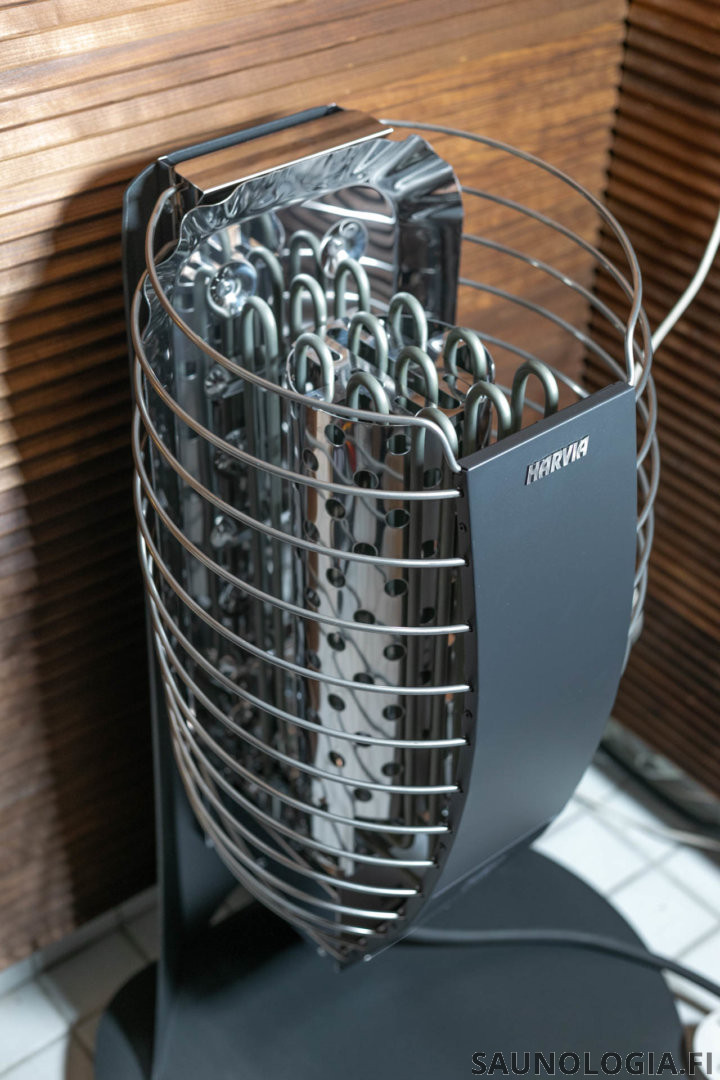
A big question for the durability and performance of an element lies precisely in its design and in the design of the heater itself. I suspect that much more important than the material of the element is correct heater design, in which both heating behaviour and durability are controlled. There are, after all, electric heaters from Finnish brands on the market in which the stones are not in contact with the elements. This substantially reduces the load on the elements. For example, Narvi’s Heat commercial heater and Combi steam heater, as well as several Harvia commercial heaters, are built in this way. Many more models are available with partial shielding, such as very popular Harvia Cilindro. In the equation for predicting the practical service life of a heater, there are therefore many variables, with the quality of the elements being only one of them, and its weighting factor still remains unknown.
Thanks to the experts interviewed:
Johnny Törnroos, Loval; Mikko Auno, Meyer-vastus; Pekka Stef, Narvi and Jari Manner & Stefan Sullivan, Tulikivi.